
Are CPL horses in pain – and what can we do if they are?
CPL Awareness CIC Support Group community member Rachel recently asked this question:
“I don’t know the best way to ask this so I hope it makes sense  . Is there any information or knowledge about how much pain CPL causes? So Gem is sound no concerns there, but over the last few years I’d say that I’ve noticed that, I don’t want to say unwilling as I know it’s not her fault, she’s not moving forward as freely when ridden. Recently she has a painkiller for something unrelated and she was far more forward.
Just now she is also really averse to getting her heels clipped, and has shown signs with the farrier of pain and discomfort, so I’m sure there is pain of some description. It just got me thinking, I understand if there isn’t an answer.”
This is a really important subject and one we understandably find difficult to give a black or white answer to. Here is my response:
Info on how CPL affects horses wellbeing is slim to none. We can take what we know about human primary and secondary lymphoedema (it can be painful and exhausting) but that isnt the same as CPL so there is little comparison there. The NHS cite a “heavy and achy feeling” as one of the symptoms of lymphoedema; along with “hard, tight, thickened skin” and that at least certainly applies to CPL as well as it does human lymphoedema. Fortunately in most cases CPL is a slow start and progression so acute pain is unlikely unless there is, for example, an infection causing a major flare up – cellulitis being a major complication of lymphatic disease.
Using emollient products (both as a soap substitute and a leave-on cream) to keep the skin supple is really important, Again from human lymphoedema we know that when the skin is dry and tight, it is unpleasant. Avoid products with “cooling” ingredients as these tend to be a double-edged sword – sometimes irritating already compromised skin.

I don’t think there’s any way that CPL wouldn’t make the horse feel poorly sometimes, but when that is, is unknown. I think we can assume that the more advanced the CPL becomes, the more uncomfortable it can be – especially when its so extreme that mobility is compromised. The fibrotic folds and nodules can, over time, become rock hard and only with xrays can we see the impact of that on the inside of the legs. It caused my own horse to have calcification of the DDFT and the vet questioned whether it also caused his unusual presentation of sidebone and ringbone. See image below.
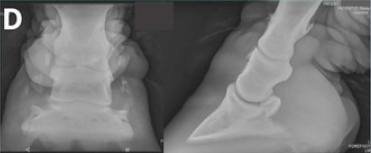
Per Debs Crosoer at Hoof Geek – we can fairly confidently say that many CPL horses live with a low level inflammation in their hooves and that absolutely will be painful if not managed and supported by way of correct and sympathetic trimming, flexible composite shoes or boots with pads and pain relief. Low grade laminitis, fundamentally. It is essential that your hoofcare provider understands CPL horses can need more breaks during their trim or shoeing or may need little walks around. Oh and if the feather is intact, not to pull on it! I can’t stress enough how necessary it is to regularly check for and treat thrush in the hooves. That will be painful and can also be a site of myiasis (fly strike, maggots).
Sores hurt, we know that ourselves and from how many CPL horses dislike their legs being handled until they are healing. So spot treating those with appropriate topicals, antibiotics, etc, as soon as you see them is another way to mitigate possible discomfort.
Going back to human lymphoedema, reports are many that when the legs are filling it causes an unpleasant “creeping” sensation similar to or even diagnosed as restless leg syndrome… Yet another complication. There is some evidence that restless leg syndrome is linked to venous disease and lymphoedema in human medicine. This is another very good reason its important not to restrict movement (unless absolutely necessary). A lot of CPL horses tend to stamp their legs when stabled or during/after exercise because of that feeling. We should be paying more attention to that (if we have ruled out feather mites as a cause of the behaviour), being careful that if we suspect the horse is experiencing such sensations, we are not limiting their access to relief – movement – by keeping them stabled.
There is a lot of discussion these days around regularly stabling horses and the welfare concerns associated with it but when we are talking about horses with lymphatic disease, it’s not an opt-in/opt-out situation. They physically, mentally, emotionally NEED to move and their bodies will be constantly telling them that. As caregivers, yard owners, industry professionals, we need to throw out tradition and personal bias and support these horses to have what they need most.
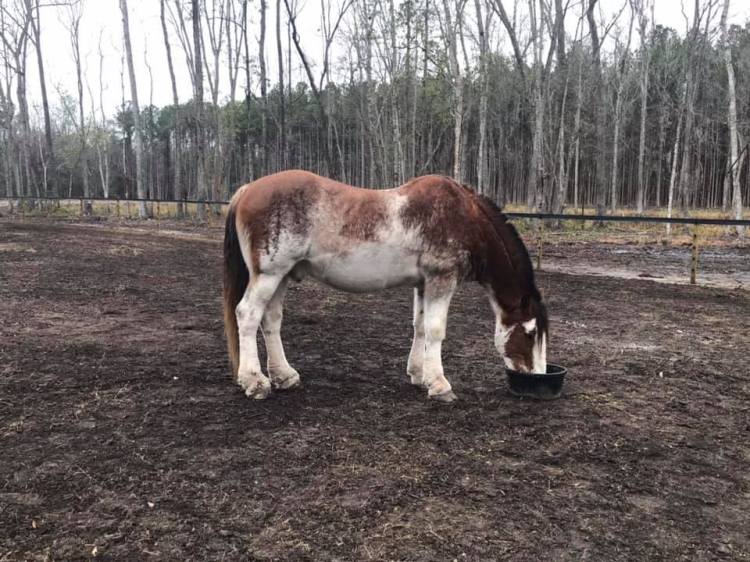
Fundamentally, the answer (as with so many CPL things) is that we don’t know because nobody has really thought to find out. So learn the signs of pain/discomfort and learn what is normal for your horse – not comparing them to other horses.
Info on detecting pain signals, management and signs of laminitis https://www.abbeyequine.co.uk/…/pain-recognition-and…
Conclusion: we probably need to be managing pain and inflammation better in CPL horses, whether that be through diet (using remedies like willow, boswellia or devil’s claw) and movement or seeing the vet for bute/danilon during flare ups. A flare up predominantly being inflammation, maybe NSAIDs should be deployed more readily, but then we also need to think about the potential effect on the gut and protect that too.
Complimentary pain relief options for CPL are typically and understandably limited because the legs are not suitable for the compression garments that would be the go-to in human lymphoedema care. Maybe explore k-taping or MLD and while not expecting too much in the way of visible results, could they help the horse feel better to some degree in the short term? Anecdotally, applying warm (NEVER hot) compresses may provide some temporary relief. But again, we eventually come back to gentle, consistent exercise and analgesia being the big improvers.
Always contact your vet urgently if your horse seems to be in pain or suffering.
Tangent: Are we using pain relief enough for equines, solely for their wellbeing, where there is no end goal of improving performance?
Lameness
CPL itself rarely causes lameness but the many conditions than can occur as a result of the disease can indeed make the horse lame. Thrushy hooves, poor hoof quality, laminitis, infection, moisture-associated skin damage/intertrigo, boney changes from stomping their feet… Is there even an end to the list of problems secondary to CPL?
Can a horse be lame purely from the disease? Yes… Never say never! However (generally speaking), this tends to happen when the disease is discovered too late and is so far progressed that the lower leg is encased in fibrosis and essentially immobile. As such, it is always best to consult your vet promptly when your horse goes lame so that they can investigate the cause. This is not to say your horse won’t go lame, it’s just that you need to know why.
How to recognise lameness in your horse – from The Blue Cross.
 Chronic Progressive Lymphoedema